
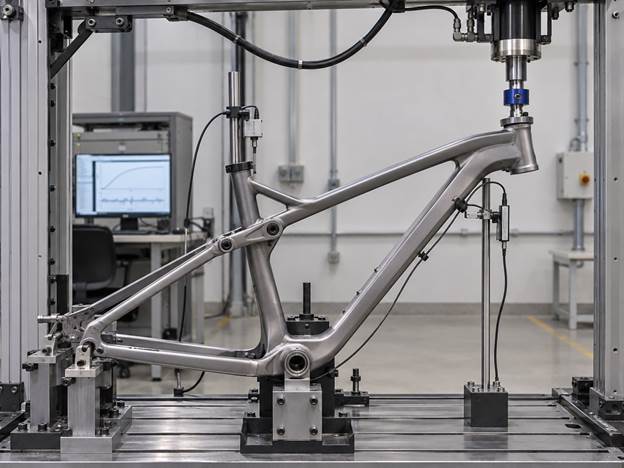
Fidelis’ FEA services team has helped customers with a whole host of different engineering challenges, utilizing simulation to provide invaluable design direction and reduce product development costs. Here, we take a look at just one example of that, with the goal of highlighting our capabilities, process and, ultimately, the value we provided to the customer.
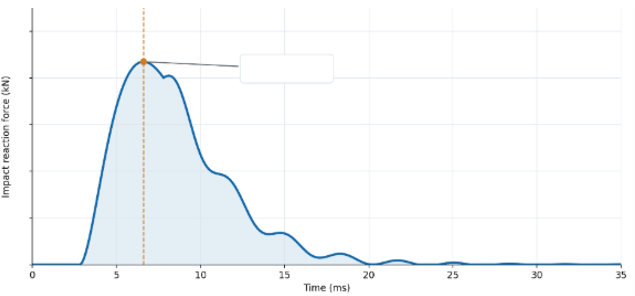
We all know that simulation is capable of providing insights into a large number of design iterations quickly and efficiently. This analysis exemplifies exactly that – and how the results allow selection of optimum designs prior to any physical testing. Of course, we can’t include the real results of the analyses – NDAs are important – but a simplified version shows what the results looked like.
Problem Statement
The customer, a large supermarket chain, wanted to assess a new frame design against a series of industry-standard structural and fatigue tests. These included loading scenarios representative of pedaling, braking, vertical impacts, and repeated loading of the frame and fork assembly. The customer provided the frame geometry, material specifications, and relevant test requirements, with the goal of identifying potential failure locations and evaluating the overall durability of the design.
Methodology
Fidelis utilized both ABAQUS/Standard and ABAQUS/Explicit to evaluate the frame under the different loading conditions. ABAQUS/Standard was used for static structural analyses, while ABAQUS/Explicit was employed for dynamic impact events where inertia, contact, and transient loading effects were important.
The finite element model captured the frame geometry, material behavior, and appropriate boundary conditions for each test configuration. Particular attention was paid to highly stressed regions, including the head tube, bottom bracket, and tube junctions, where stress concentrations can significantly influence structural performance.
For the fatigue assessments, stress results from the relevant loading conditions were evaluated against material fatigue properties to estimate the durability of the frame under repeated cycling. This allowed potential fatigue-critical locations to be identified and provided valuable guidance for design improvements.
Results and Conclusions – Our Value
The analyses provided the customer with a detailed understanding of how the frame responded to the different test conditions, highlighting critical stress concentrations and areas potentially susceptible to fatigue damage. Fidelis worked with the customer to assess the structural performance and provide recommendations for improving the design where necessary.
By combining static, dynamic, and fatigue analysis, the customer was able to evaluate multiple aspects of frame performance virtually, reducing development risk and helping focus subsequent physical testing on the most critical conditions.
TL;DR
Fidelis utilized ABAQUS/Standard and ABAQUS/Explicit to assess the strength, impact response, and fatigue durability of a mountain bike frame, helping the customer identify critical areas and improve the design before physical testing.
