
Fidelis Industry Insights is a series focused on where modern simulation—and the SIMULIA toolset behind it—can materially change how engineering teams design, verify, and deliver products. This installment is about the medical industry: implants, surgical tools, drug-delivery devices, diagnostics, and medical electrical equipment where the cost of late surprises is high and the tolerance for risk is low.
Medical products are uniquely punishing from an engineering standpoint. You’re dealing with complex geometry, demanding reliability targets, real-world variability in anatomy and use conditions, and materials that are rarely “simple.” Add to that the need for traceable verification evidence and you end up with a development environment where test-only iteration tends to be slow, expensive, and prone to discovering issues late. Simulation is one of the few levers that consistently shifts risk forward in the program, where changes are cheaper and design intent is still flexible.
The regulatory landscape is also clearer than it used to be about computational modeling. The FDA has published guidance on assessing credibility for computational modeling and simulation used in medical device submissions, built around a risk-informed framework: the more you rely on a model for a decision, and the higher the consequence of being wrong, the more rigor you need in verification, validation, and uncertainty characterization. That dovetails with ASME V&V 40, which formalizes how to scale V&V effort to the model’s intended use and risk. The point isn’t “simulation replaces testing.” The point is that simulation, done credibly, can reduce unnecessary test loops and focus physical testing on confirmation instead of exploration.
FEA For Medical Devices
FEA earns its keep in medical because so many “simple” problems are actually contact problems, fatigue problems, or instability problems hiding behind a static load case. In orthopedic systems, the most meaningful questions often aren’t just peak stress; they’re interface mechanics. You care about contact pressure distributions, micro-motion, and the transition from stable fixation to loosening as you sweep boundary conditions across patient variability. In cardiovascular devices, deployment mechanics are everything. You’re not simply checking strength—you’re predicting how the device behaves during crimp, delivery, and expansion, and whether durability concerns show up because of local strain concentrations or fretting-like contact at interfaces.
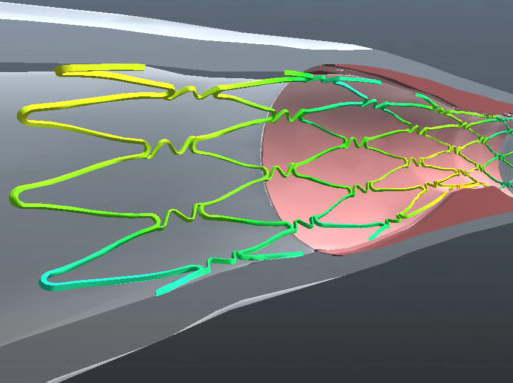
FEA is also disproportionately valuable when the environment is thermal or process-driven. Sterilization cycles, press fits, residual stress from forming, and weld or bond processes can quietly define the failure mode months later. A well-built nonlinear workflow—material nonlinearity, contact, large deformation, and the right stabilization strategy—lets you test these hypotheses early, before the program has already “locked in” the geometry.
CFD For Medical Devices
Medical fluid problems punish shortcuts. Flow is frequently transient and coupled to motion, and the fluid itself often doesn’t behave like a textbook Newtonian liquid. Even when you don’t pursue fully coupled fluid-structure interaction, CFD can still answer design questions that are hard to probe experimentally until late: what flow features appear off-design, how sensitive performance is to manufacturing tolerances, and whether the design accidentally creates recirculation pockets or high-shear regions that raise risk.
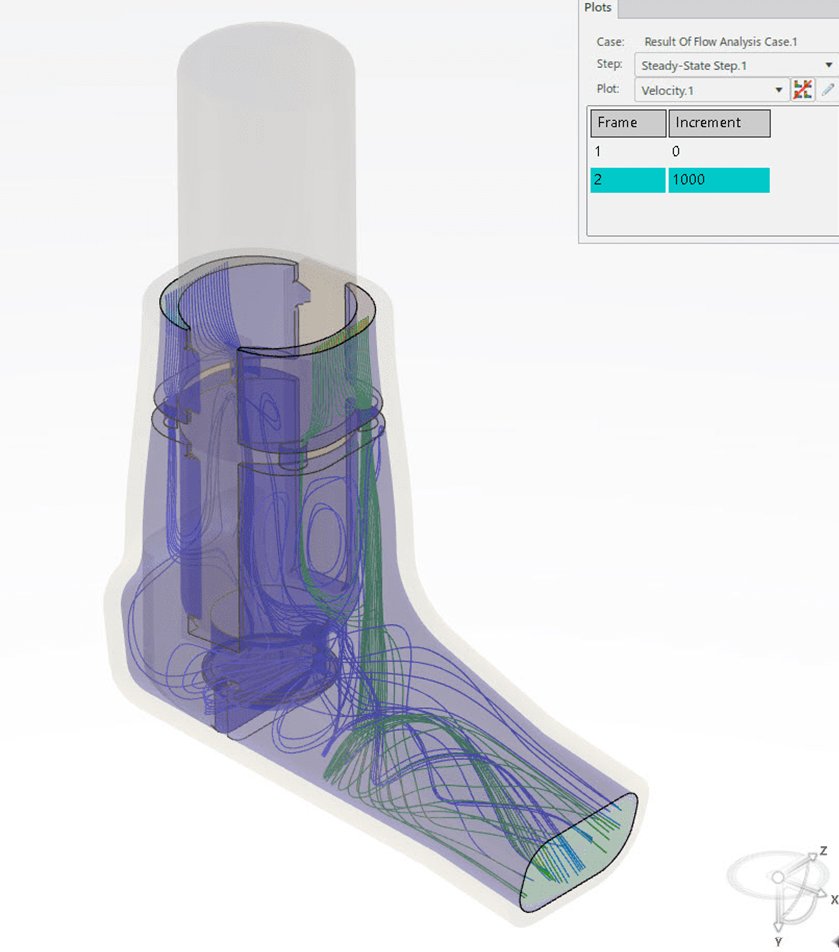
This is where CFD becomes less about a single “pretty streamline plot” and more about developing a defensible envelope of operation. In blood-contacting devices, for example, the engineering aim is often to reduce adverse flow features that correlate with thrombosis risk while still meeting pressure rise or efficiency targets. In respiratory and drug-delivery systems, the core question is whether the device delivers what it claims across a realistic range of transient waveforms. In diagnostics and microfluidics, the big wins are usually in understanding mixing limitations, residence time distributions, and the design’s sensitivity to tiny geometric variations that come from real manufacturing.
CFD doesn’t remove the need for benchtop or in-vitro testing. But it does shrink the space of experiments you need to run and makes the experiments you do run far more targeted.
EMAG For Medical Devices
Electromagnetics has become one of the most underestimated drivers of late-stage surprises. Medical electrical equipment must demonstrate electromagnetic compatibility, and the design details that determine pass/fail are often layout and integration details: cable routing, apertures, seams, grounding strategy, filter placement, and unintended coupling paths. EMC requirements are commonly demonstrated to IEC 60601-1-2, and EM simulation can help teams build margin before they ever walk into a test chamber.
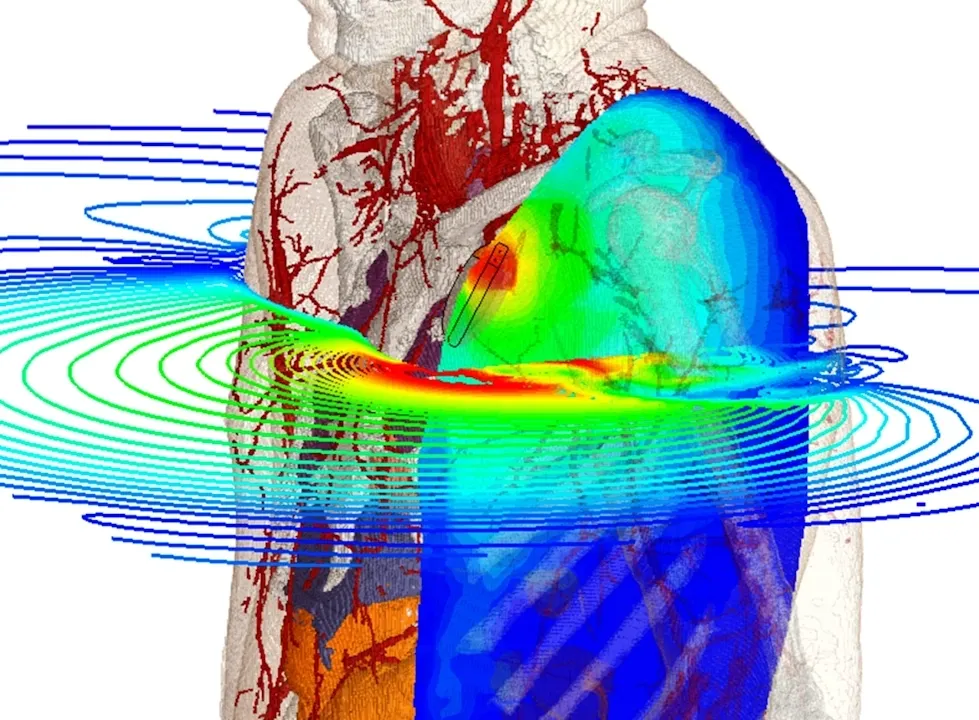
Beyond EMC, EMAG shows up in wireless connectivity and in MRI environments. Tissue detunes antennas, changes effective radiation characteristics, and can turn a lab-bench “good link” into a field failure. MRI is even more demanding because you’re not just simulating fields; you’re often following the causal chain into induced currents, power deposition, and temperature rise. The FDA’s Medical Device Development Tools program has even included qualified computational models aimed at predicting MRI-related tissue temperature rise near implants, which is a strong signal that these approaches are becoming more mainstream when the credibility story is strong.
The Real Benefit: Earlier Decisions, Fewer Late Surprises
The biggest benefit of simulation in medical isn’t that it makes the device “stronger” or “more efficient.” It’s that it changes when you learn critical information. Simulation gives you a way to explore variability early—patient variability, manufacturing variability, and use-condition variability—without building a prototype for every possible case. That changes program dynamics: fewer redesign loops, fewer late verification failures, and fewer situations where the only solution is to add conservatism that hurts performance or cost.
There’s also a documentation benefit that teams don’t always appreciate until they’re in the middle of verification planning. When simulation is built around intended use, with traceable assumptions, verification evidence, validation comparisons, and uncertainty treatment scaled appropriately to model risk, it can become part of a coherent verification narrative rather than a collection of “engineering pictures.” That mindset aligns directly with the FDA’s credibility framing.
How Fidelis Can Help
Fidelis has a raft of experience performing simulations for the medical industry. From drug delivery systems and occlusion rotoblation using FEA to micro-flow analysis with fluid dynamics, we’ve seen a lot!
And the one thing we’ve learned is that the simulation methodology must be ‘engineered’: unclear intended use, mismatched fidelity, weak validation targets, or results that are hard to defend are just a few of the pitfalls that can be encountered. Proper simulation in such a highly regulated field is equal parts physics, numerics, and process—choosing the right abstraction level, controlling model risk, and producing analysis that supports decisions.
If you’re trying to shorten cycles, reduce prototype churn, expand coverage of worst-case conditions, or build a more defensible verification story around a medical device, simulation across structures (FEA), flow (CFD), and electromagnetics (EMAG) is one of the highest-leverage moves you can make—especially when it’s custom built to be credible for the decisions it supports.
Final Thoughts
Medical engineering is the perfect environment for simulation done well: high consequence, high complexity, and high leverage when you can replace “prototype-and-pray” with simulation-driven design across structures (FEA), flow (CFD), and electromagnetics (EMAG). If you’re trying to shorten design cycles, expand coverage of worst-case conditions, or build a more defensible verification story around your medical products, simulation is often the highest ROI step you can take—especially when it’s set up to be credible for the decisions it supports.
Fidelis has extensive experience in performing engineering simulation in the medical field, and if you’d like to take advantage of that in your next design effort, don’t hesitate to get in touch with our expert team today!
